
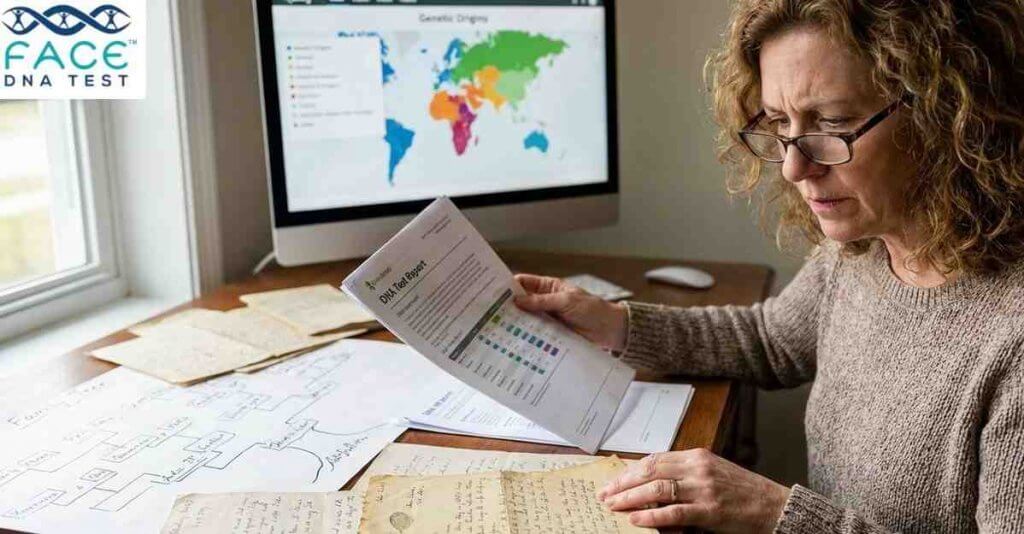

Did you ever ask yourself why your family is called that? Your name has hints as to the place your ancestors lived, the kind of work they performed, or the name of their parents. The name of your family is like a breadcrumb that has taken you to the beginning of history. Although old documents and records can tell part of the story, modern DNA testing provides strong tools to confirm ancestral relationships and uncover family secrets that paper trails cannot reveal. We are going to investigate the work of surnames and also how genetic testing can enhance your family history.
What is my last name, and how can DNA testing be used to trace my family name?
The name of your ancestors, where they lived, what they did, or the name of the father or a word of description is usually used as the last name. Hill or Rivers were names of the areas where families were located. It was like Smith or Baker gave us the clue about what people were doing. Face DNA’s DNA testing shows whether individuals with the same surname as you are biologically related or not. Ancestry DNA tests demonstrate the geographic DNA origins that often align with the historical regions of your surname. This genetic information can confirm family ties, and it can reveal other areas of your family tree that you were not aware existed.
The Confirmation of Ancestral Lineage by DNA.
- DNA testing identifies you with biological relatives bearing your surname.
- Findings reveal whether the names of surname bearers are biologically connected or are by chance.
- Percentage geographic ancestry establishes the fact of your DNA being a match to your surname’s region of origin.
- Genetic markers follow the migration patterns, which are consistent with the maps of the distribution of surnames.
- The relationship DNA tests offered by Face DNA confirm biological relationships among individuals with the same surname.
Why are surnames usually inherited, and what is wrong with records being misleading?
The majority of cultures transmit surnames of fathers to their children, although not all traditions are the same. In certain cultures, the maternal name is taken, or both the names of the parents are combined. The records might not be accurate as the surname spelling changed over time, when the family immigrated, or changed entirely due to different reasons. Paper records can be incomplete due to adoption, remarriage, or informal name changes.
Evidence of Naming Patterns in the Past.
- DNA tests reveal whether the old-fashioned father-to-children surname associations were true in your family.
- Genetic evidence also shows that the name changes occurred several generations ago.
- Y-DNA testing particularly follows the lines of the paternal surname by following the males in the family tree.
- Findings indicate at what point surnames were absorbed, changed, or given the wrong name in documents.
- Face DNA has scientific evidence that either confirms or disproves past naming presumptions.
Gaps in Paper Records
Inaccuracies, spelling, and omission of information are common in birth certificates, immigration documents, and census documents. Natural calamities, fires, and wars burned thousands of historical documents. DNA testing bridges these loopholes by providing biological evidence alongside historical records.
What are the most effective DNA tests in the field of surname and lineage research?
There are three predominant types of DNA tests that assist in tracing the surname and also the family line. The inheritance of DNA is in the direct paternal line and surname through fathers. DNA test authenticates all the lineages of ancestors and identifies you with family members irrespective of the surname. DNA testing is able to trace your immediate maternal ancestry through your mothers. Face DNA is a complete DNA testing of lineage that assists in establishing the presence of genetic kinship and affirming surname kinship.
Y-DNA, Autosomal DNA, and mtDNA
- Y-DNA: Only fathers to sons, an unbroken lineage of paternal surname, men with the same Y-DNA and same surnames are cousins by their male line, most effectively used in traditional surname studies.
- Autosomal DNA: Calculates the chromosomes of all ancestors; identifies relatives through any family line, regardless of the surname; displays percentages of ethnicity and geographical ancestry; assists in searching for relatives who have any line of your family.
- mtDNA: Only traces of the mother-lines of mothers to all children; surnames are usually not traced in most societies; maternal lineage is good in searching the ancestry of the mother and migration history by lineage.
Genetic Results and Family Names.
The closer the relationship between you and the other person is, the more likely you are to have a common ancestor. Such genetic links are useful in constructing proper family trees and validating the origin of the surnames.
Is it possible to detect changes in surname as a result of adoption, migration, and name changes through DNA testing?
DNA testing can reveal concealed surname changes that paper records cannot show. When parents adopt children, official records often lose the children’s native family surnames, but their DNA still carries them. Immigration also often changes complex surnames into simpler ones, and foreign names frequently change to English. Individuals on the run altered their names completely. Face DNA tests of your ancestry prove that this or that surname is only a face on the document, but does not show your real biological ties. The DNA correspondence to other names means that there was a change of name at some point in your family. Such genetic proof assists adoptees in locating birth families and any individual in unraveling hidden family ties.
Discovering Hidden or Lost Ancestries.
The mismatch of DNA with unknown surnames is an indicator that there are name changes that took place in your lineage. Such things are frequently discovered as adoption, non-paternity cases, or deliberate changes of names. DNA testing identifies biological relatives despite the fact that the surnames do not give any hints that they are related. Face DNA relationship DNA testing is the test that establishes the exact biological connections that make you match other individuals whose last names are different from yours.

Conclusion
Learning the history of your surname is a merger between the historical and the present-day genetic studies. Face DNA is a lab that deals with ancestry DNA testing, relationship DNA testing services, and is involved in assisting people to identify their family lineage and verify the connection between names. The result of our certified lab is to combine you with your relatives, determine the percentages of your ethnic composition, and find geographic reasons that agree with the history of your surname.