
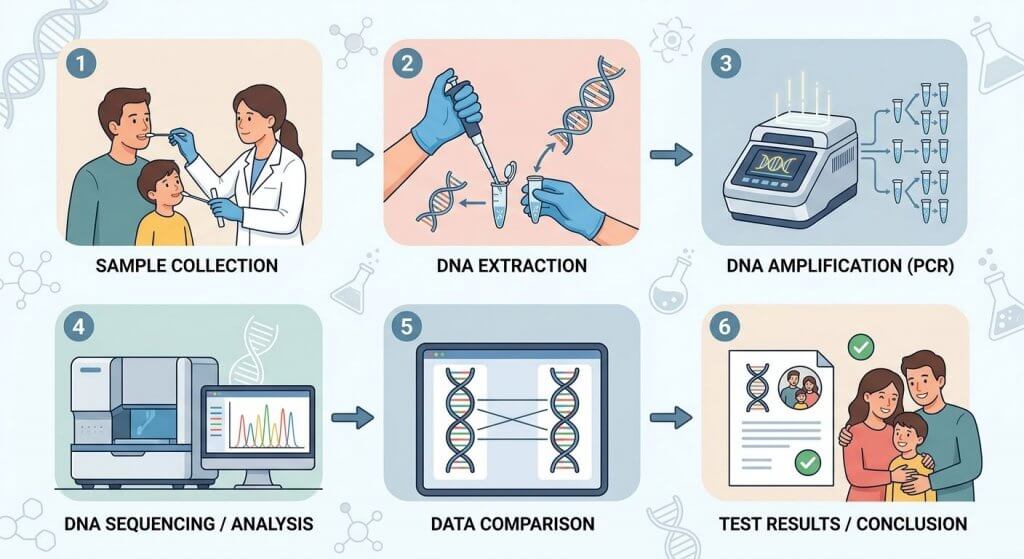

A paternity test works by comparing the DNA of a child to the DNA of an alleged father to figure out whether a biological relationship exists. Knowing what is a paternity test? in the first place, is kind of the first move toward getting the clarity you need. The whole thing is fairly straightforward, scientifically trustworthy, and surprisingly more accessible to most people today. Whether you’re looking for results for personal peace of mind or for something legal purposes, DNA paternity testing follows a pretty clear sequence from sample pickup to the final result.
How Does a Paternity Test Work, From Start to Finish?
A paternity test works by taking DNA samples from the child and the alleged father, then sending them to a certified laboratory, where they analyze specific genetic markers that come from biological parents. The lab compares DNA profiles to decide whether the alleged father could have contributed the child’s DNA. And when people ask about paternity test meaning, it isn’t only about the end result it’s about getting a scientifically supported answer to a question that has real personal, and legal weight.
Overview of the DNA Testing Process
The following step-by-step guide explains how is a paternity test done:
- Step 1: Sample collection: DNA is collected from the inside of the cheek using a simple cotton swab. It’s painless, non-invasive, and usually takes just a few minutes for each person who is involved. The cheek swab of father and the child is collected.
- Step 2: Sample packaging and submission: The collected swabs are put into sterile packaging, labeled properly, and sent to a CLIA accredited laboratory for analysis.
- Step 3: Laboratory DNA extraction: In the lab, DNA is pulled from the cells collected on the swab and the genetic material needed for comparison is isolated.
- Step 4: Genetic marker analysis: The lab looks at a set of specific genetic locations, called loci, and then it builds a DNA profile for each person being tested.
- Step 5: Comparison and result generation: The child’s profile is basically checked against the alleged father’s profile. The outcome will either confirm or remove biological fatherhood, depending on whether the profiles share the expected inherited markers. And yeah, it’s that matching part, that’s doing most of the work.
What Steps Are Involved in Collecting DNA Samples for a Paternity Test?
How to do a paternity test really starts with collecting samples correctly, and honestly, it’s simpler than most people think. The cheek swab approach is what most reputable DNA testing services use, because it’s non-invasive, tidy, and gives dependable results when it’s handled correctly.
Swab Collection and Sample Handling
Prepare before swabbing: Try not to eat, drink, smoke, or chew gum for at least one hour before the sample is taken. A clean mouth, really means a cleaner sample too, with fewer contaminants that can interfere in the analysis, even a little.
Swab the inner cheek: Hold the swab, press it firmly on the inside of the cheek, then move it in a little rotating motion, for about ten to fifteen seconds. This action gathers enough buccal cells for the lab DNA extraction.
Let the swab air dry: Before you put it into the included sterile envelope, wait until the swab is fully dry. Any leftover moisture can basically help bacteria multiply which then messes up the specimen during shipment, so no rushing it.
Label and seal properly: Each swab should be clearly labeled with the donor’s name and how they are related to the child. Wrong marking is one of the most common reasons for re-collection, and nobody wants that kind of delay or extra steps.
Submit quickly: Send the samples to the lab as soon as possible after collection. At-home DNA test kit from Face DNA includes pre-addressed packaging, so it feels kind of easy, almost effortless, from start to finish.
How is DNA used to figure out biological fatherhood?
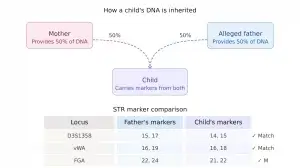
Every person gets, pretty much exactly half of their DNA from each biological parent. When a lab does DNA paternity testing they don’t just scan everything randomly, instead they check certain spots in the genetic code, called STR markers. Those places tend to be more distinctive and easier to measure.
Genetic markers and the matching process
STR marker analysis usually looks at something like 16 up to 24 specific genetic locations at the same time. At each location, the child will have two markers, one that comes from the mother and another that comes from the biological father. If the alleged father’s markers match the child’s paternally inherited markers at every location that was tested, then biological fatherhood is supported with a high degree of scientific confidence.
Exclusion is definitive, and this part is important. If the alleged father does not carry the expected markers that should line up with the child at multiple locations, then he is excluded as the biological father with 100% certainty. There is no real gray space in a properly conducted paternity test. Either the evidence supports the relationship, or it doesn’t.
How Accurate Are Modern Paternity DNA Tests?
How long does a paternity test take, and how reliable is it, are two questions people ask a lot before they start. Usually results come back in about three to five business days after the lab gets the samples. The reliability stays very strong especially when the testing is done by a qualified, accredited laboratory.
Reliability and Scientific Confidence Levels
If biological fatherhood is confirmed, today’s paternity DNA tests often state a probability of paternity of 99.9%. That statistical strength is generally enough for both personal peace of mind and court-related needs, as long as you use a legal DNA testing service with the right chain of custody steps.
How early can you do a paternity test? With Non-Invasive Prenatal Paternity, or NIPP, paternity can be established as early as seven weeks into pregnancy using a maternal blood sample. There’s no invasive procedure involved. At Face DNA, we offer Non-Invasive Prenatal Paternity Test services through accredited partner laboratories and advanced DNA analysis methods, as well as legal DNA testing services and at-home DNA test kit options. All results are processed through CLIA-accredited labs, so you have something you can rely on.

Conclusion
Whether it’s for personal reassurance or for legal reasons, DNA paternity testing gives a fast, non invasive, and highly dependable solution to those unanswered questions about biological fatherhood. With today’s genetic science improvements, the outcomes are usually more accurate and easier to access than before, and they can show probabilities of 99.9% or higher when paternity is confirmed. In the end, knowing how a paternity test works helps people make more informed decisions, and get the clarity they want, backed by strong scientific evidence. Face DNA offers dependable and confidential DNA paternity testing services through accredited laboratories, so individuals can receive accurate answers with trusted scientific backing, and a smooth pathway from start to finish.