
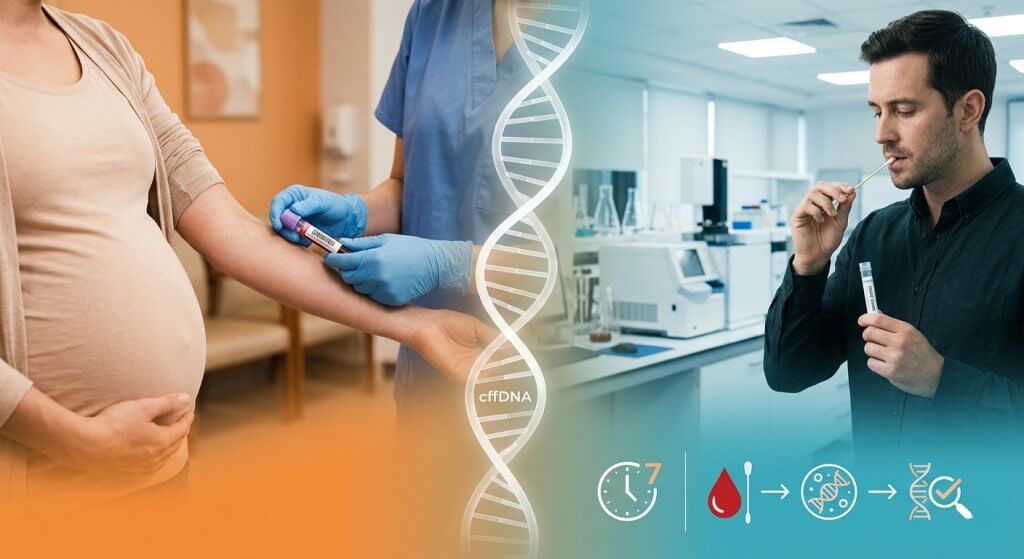

A DNA test can be performed on an unborn baby as early as 7 weeks into pregnancy — safely and non-invasively. With advancements in DNA technology, prenatal testing (before birth) for the father is now possible without risk to the baby. You may have questions how early can you do a DNA test on an unborn baby, depending on what type of test you’re interested in. This blog covers the available prenatal paternity test while pregnant options, accuracy, safety, when to test, and how much prenatal paternity testing costs.
Can You Do a Paternity Test While Pregnant?
Yes, if you are wondering, “Can you do a paternity test while pregnant?“, the answer is a definite yes. Today, we can even determine whether or not a child is her father long before he is born, or even conceived, by using DNA testing.
A non-invasive prenatal paternity test (NIPP) is the safest and earliest possible test. With older prenatal testing, it was necessary to take samples from within a woman’s uterus, whereas NIPP involves a simple blood sample from the mother and a DNA sample from the claimed father.
If you are one of those who are asking if you can get a paternity test during pregnancy, this is the best and most accurate way without the risk of causing harm to your pregnancy. A paternity test during pregnancy can be conducted, and the results can be known earlier to give families the decision-making power and eliminate uncertainty.
There are several forms of prenatal testing, each with varying time of use, cost, and indication. It is important to know how a test works so you can select the best one for you.
Non-Invasive Prenatal Paternity (NIPP) — available from 7–9 Weeks.
By now, the earliest and safest available means of determining paternity is a non-invasive prenatal paternity (NIPP) test.
Cell-free fetal DNA (cffDNA) is a naturally occurring cell-free fetal DNA which is present in the mother’s blood since 7 weeks of gestation. A sample of blood is drawn from the mother during the test, and advanced testing methods separate the fetal DNA from the maternal DNA.
The potential father gives a cheek swab test. The genetic markers, called STRs for Short Tandem Repeats, are then matched with the DNA profile from the alleged father. If the markers are the same, the paternity can be confirmed with a very high level of certainty.
NIPP testing is accurate to over 99.9% when performed by a laboratory accredited by AABB. The procedure is a simple blood draw from the mother, which does not pose any risk to the developing baby.
It should be noted that most NIPP tests are not legal. Results are very reliable but seldom accepted in court unless taken in a controlled legal chain-of-custody.
At Face DNA Test, we provide a non-invasive prenatal paternity test that can be performed starting at 9 weeks, and with results due to you in 3-7 business days from an AABB-accredited laboratory.
Does the father have to be present for a prenatal paternity test?
The alleged father does not have to be present at the same appointment as the mother, but he should submit DNA for testing.
A prenatal paternity test cannot be conducted from just the mother’s DNA and the baby’s DNA. To prove a biological connection, the lab needs to compare the fetal DNA with the alleged father’s DNA.
For many parents, it is possible for mother to give her blood sample and father to give his cheek swab at separate locations. Often, tests can be sent out separately so each participant can do their own test at a time that is convenient for them.
If scheduling difficulties, distance, or privacy concerns make it easier for families, separate collection options may make the testing process more manageable, and results are reliable.
Other DNA Tests You Can Get While Pregnant
Even though you may have no idea that you can get a DNA test while pregnant, it is worth noting that not all prenatal DNA tests are used to determine paternity.
There are tests that are designed to specifically test for genetic conditions or chromosomal abnormalities. The medical tests are for a different purpose than prenatal paternity testing.
NIPT — Cell-Free DNA Screening From Week 10
- Non-Invasive Prenatal Testing (NIPT) is a medical test for screening, which is generally carried out from 10 weeks of pregnancy onwards.
- NIPT is similar to NIPP and involves testing cell-free fetal DNA in the mother’s bloodstream. But it’s for a different reason. NIPT is not designed to identify the father, but rather to detect chromosomal abnormalities like Trisomy 21 (Down syndrome), Trisomy 18 and Trisomy 13.
- NIPT has very high accuracy as a screening test, and is not associated with any risk of miscarriage as it involves only a blood draw from the mother. The test can also determine the baby’s sex earlier than conventional ultrasound tests.
- NIPT is not a paternity test, though, and cannot determine the biological father.
CVS (chorionic villus sampling) — diagnostic from 10–13 weeks
A chorionic villus sampling is a diagnostic procedure that is performed between 10-13 weeks.CVS (Chorionic Villus Sampling) is a diagnostic test performed at 10-13 weeks.
Chorionic Villus Sampling (CVS) is an invasive diagnostic test that is done between 10%-13% of pregnancies.
-
- CVS involves taking a small piece of placental tissue. The sample can be tested for chromosomal problems and used to determine paternity since the cells from the placenta contain the baby’s DNA.
- CVS samples are tested for diagnostic level accuracy and may be used to perform a court-admissible paternity test if all legal procedures are followed.
- CVS does, however, have a slight (1%) chance of a miscarriage. Given this risk, the medical community has tended to recommend CVS only when there is an appropriate medical indication. Learn more about the difference between nipt and CVS.
Amniocentesis — most accurate, from week 15–20
Amniocentesis is another prenatal diagnostic test that is invasive and is usually performed at 15-20 weeks of pregnancy.
- During the procedure, a needle is inserted a small amount of fluid around the baby is collected. The fluid can be used to study the child’s genes for the diagnosis of genetic diseases and for paternity testing.
- When collected using the legal procedures, amniocentesis is considered the gold-standard diagnostic test and can yield court-admissible paternity results.
- A tiny risk of miscarriage, usually about 0.1-0.3%, is associated with amniocentesis; it is very accurate. It is most often recommended if the pregnancy is deemed to be at risk or if previous screening tests have raised some concerns.
How much is a DNA test while pregnant?
The price of a DNA test during pregnancy will vary, depending on the specific test being ordered and the lab conducting the test.
The price of a non-invasive prenatal paternity (NIPP) test is generally $400 to $2,000. The price will differ according to the turnaround time, laboratory accreditation, and if an expedited processing request is made.
The price for NIPT screening ranges from $800 to $3,000, with insurance coverage of part or all of the expense, if medically advised.
CVS and amniocentesis are usually more expensive, ranging from $1,000 to over $5,000. But they may be covered under insurance if they are deemed necessary for the health of the individual.
There are some factors that affect pricing:
- AABB laboratory accreditation
- Testing can be either legal or informational. There are two types of testing: legal and informational.
- Turnaround speed
- Sample collection requirements
- The fees charged at the clinic and the participation of the physicians.
For additional information, visit how much does it cost for a DNA paternity test, and who pays for a dna test for child support
At Face DNA Test, we offer very competitive prices for prenatal paternity testing, and there are no hidden charges or costs. See the DNA testing current prices.
Legal vs Informational Prenatal DNA Tests — What’s the Difference?
It is significant that the difference between legal testing and information testing is noted.
The main use of informational prenatal DNA testing is to provide information. This is the type of home NIPP test most are found. Although very accurate, the results are not admissible in court as it does not follow strict identity verification procedures.
A Chain of Custody is a requirement of the law for prenatal DNA testing. Participants will need to bring identification, samples will need to be collected by authorized individuals and testing will need to be done in an AABB accredited laboratory.
Legal consequences can be applied on child support, custody issues, inheritance claims and other court matters.
People who are looking to find peace of mind opt for informational testing. People who are expecting to go to court should ask for a legal test from the outset, to prevent the need for repeat testing later. To find out more, please read the difference between home vs legal DNA tests.
Is It Safe to Get a DNA Test During Pregnancy?
One of the most important concerns of a pregnant woman is safety.
- Non-invasive tests like NIPP and NIPT are safe, as they involve taking a blood sample from the mother. No direct contact with the baby, placenta or amniotic sac.
- CVS and amniocentesis are not the same. There is a very small risk of a miscarriage with these procedures, as they require the collection of tissue or fluid from inside the uterus.
- The risk for CVS is typically low (less than 1%). The risk for amniocentesis is usually determined as being between 0.1% and 0.3%.
Before anyone chooses to have an invasive prenatal test, they should consult their OB-GYN about the pros and cons. There are options for most families that are non-invasive, that even the elderly and disabled can receive.
How to Obtain a Prenatal DNA Paternity Test Step by Step
- Confirm gestational age. Only consider NIPP testing if the pregnancy is at least 7 weeks along.
- Select the type of test to perform. Make a choice between informational testing (NIPP) and legal testing (CVS or amniocentesis)
- Get a testing kit or schedule a test. Online ordering or in-clinic pick-up is offered by many providers.
- Provide samples. The mother gives one blood sample, and the alleged father gives one cheek swab sample. Samples may be taken as individual samples.
- Submit samples for analysis to an AABB-accredited laboratory. Laboratory accreditation is a way to improve quality and accuracy.
- Receive results. The majority of NIPP results can be obtained within 3-7 business days of all necessary samples being received by the laboratory.

Final Thoughts
If you are thinking about how early can you do a DNA test on an unborn baby? Well, with today’s technology, it’s possible to test DNA as early as 7 weeks of pregnancy! A non-invasive paternity test during pregnancy offers results that are extremely accurate, and poses no risk to the baby.
It is important to know the difference between informational and legal testing before selecting a test. If you are eager to know, Face DNA Test offers a safe and non-invasive prenatal paternity test. Samples are sent to an AABB-accredited lab to be processed, and results are returned in days.
FAQs
Can you get a DNA test while pregnant without the father knowing?
The alleged father must provide a DNA sample (cheek swab or blood test) for a valid result. A test using only the
mother’s DNA cannot confirm paternity. However, samples can be collected separately, so the father does not need
to attend the same appointment.
How accurate is a prenatal paternity test?
Non-invasive prenatal paternity tests from AABB-accredited labs are 99.9%+ accurate. Invasive tests (CVS and
amniocentesis) are essentially 100% accurate diagnostically. Accuracy depends on sufficient fetal fraction,
gestational age, and laboratory quality.
Is a prenatal DNA test admissible in court?
Only tests conducted under a strict chain-of-custody protocol by an AABB-accredited laboratory are
court-admissible. At-home or mail-in NIPP kits are informational only and cannot be used in legal proceedings such
as child support or custody cases.
Does a prenatal DNA test hurt the baby?
Non-invasive tests (NIPP, NIPT) carry no risk to the baby; they require only a blood draw from the mother.
Invasive tests such as CVS and amniocentesis carry a small miscarriage risk of less than 1%. Your OB-GYN can
advise whether an invasive test is necessary.
Can twins cause problems with a prenatal paternity test?
Fraternal twins can theoretically have different fathers, a rare condition called heteropaternal superfecundation.
Each twin would need to be tested separately. Identical twins share the same DNA and therefore always have the
same biological father. Always inform your lab if you are carrying twins.