
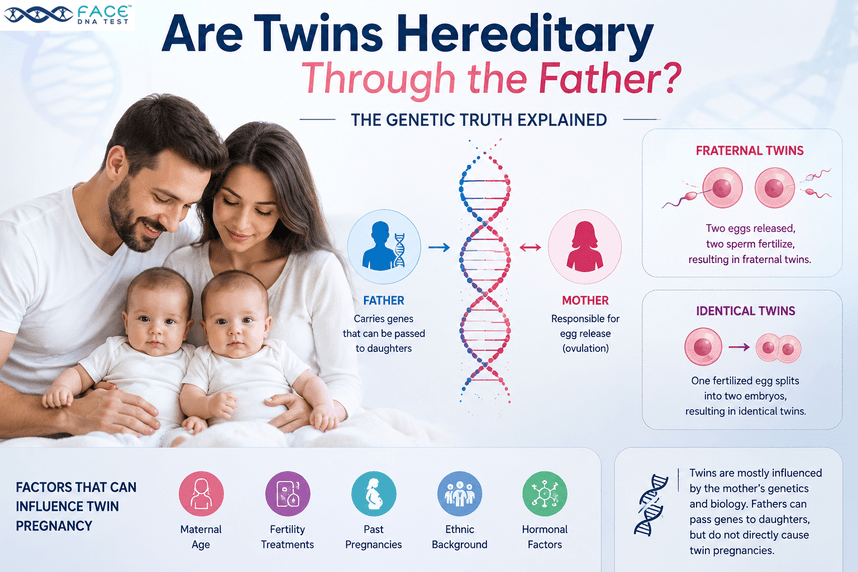

Many people ask if twins run in the family and if the father can cause twins. You hear this a lot, especially when there were twins in the previous generations. Some folks say twins come from the father’s side, and other people insist the mother is the real cause. But honestly, the truth is less mysterious and more scientific than those myths make it sound.
The quick answer is that fathers don’t directly cause a twin pregnancy. Still there can be a small indirect effect mostly because certain traits can be passed along in the wider family line. Once you get a grip on the basics of how twins happen, then it’s a bit easier for families to sort real things from the tales that keep getting repeated, and sometimes they do sound sensible even if they’re not.
Are Twins Hereditary Through the Father?
Fathers don’t really, directly influence if a woman ends up pregnant with twins. It’s mainly because the father has no say in how many eggs get released during ovulation.
To get fraternal twins, a woman has to release two eggs in the same cycle. That part happens in the mother’s body, not his. The father is there for sperm, while the mother’s ovaries are the ones that manage the egg release timing and number. So in basic terms, he can’t make twins happen on purpose, because he does not control the egg count.
Genes still can matter in a sort of indirect, off to the side way. A man may carry inherited variants, and these are linked with higher odds for twin pregnancies, and then he passes those variants on to his daughters. Later, those daughters might end up with a better opportunity for having fraternal twins on their own too.
How Fraternal Twins Actually Happen?
Fraternal twins occur when two separate eggs are released (hyperovulation) and are fertilized by two separate sperm cells, but it’s not one of those neat, single-step things. It’s more like the ovaries do their own thing for a moment, then each egg can be fertilized by its own sperm.
Some key ideas:
- A woman releases two eggs instead of one.
- This is called hyperovulation, which can almost sound like something fancy but it’s basically that extra release.
- Hyperovulation can run in families , especially across the mother’s line.
- The genetic tendency is connected to women.
- And the father does not really control egg release, not the number of eggs anyway.
Think of it like this: the mother’s body is the one deciding how many eggs are released, while the father’s sperm just fertilizes the eggs that are already waiting. So that’s why fraternal twins are mostly tied to the mother’s side of the family , and less to the father’s background.
Can Fathers Carry the Twin Gene?
Yes, fathers can end up carrying genes that are connected to twinning, but it’s pretty indirect. A father might have inherited variants tied to hyperovulation from his own family line. Even if he can’t use those variants directly to make twins himself, he still can pass them along to his daughters.
Then, if his daughter ends up inheriting those same variants, she may later release more than one egg around ovulation. That part can raise her likelihood of having fraternal twins.
That’s also why folks sometimes say twins “skip generations”. In real life though, the heredity trait can just travel quietly through men until it lands in a daughter who can, biologically, express it.
Medical professionals usually take time to explain it this way, since quite a few families misread how twin traits get handed down.
What About Identical Twins?
Identical twins are very different from fraternal twins, even if people mix them up, sometimes.
Identical twins happen when one fertilized egg breaks off into two separate embryos very early during pregnancy. From what scientists say right now, this is largely a random thing, not something planned.
Important points:
- Identical twins are not usually treated as hereditary
- They typically do not “run” through families
- Neither mom nor dad directly causes identical twins
- The split comes about naturally, kind of without a clear trigger
Researchers keep looking into twin genetics, yes, but the medical picture we have so far doesn’t show a strong inherited pattern for identical twins in the way family traits usually do.
Family History and Twin Probability
Twins can sometimes seem to run in families, especially when you look at the mother’s side. It’s not always obvious, but this often happens because hyperovulation might be passed along through female relatives, kind of like a quiet pattern.
For instance, a woman may have a better chance of fraternal twins if her mother or grandmother also had fraternal twins. Not in every case, but the connection can show up more often than people expect.
Factors influencing how likely a twin pregnancy is to happen:
- Maternal age
- Fertility treatments
- Past pregnancies
- Ethnic background
- Hormonal differences
Since heredity is pretty complex, plenty of families end up wanting professional guidance once questions about inheritance come up. Face DNA provides DNA testing services that can help families clarify biological links and genetic connections through options like DNA paternity testing services, Y DNA, and mtDNA Testing.
Common Myths About Twin Inheritance
A lot of twin stories are really popular, but honestly they are not medically accurate, not even close.
| Myth | Fact |
| Twins somehow skip generations through men. | A man can pass along genes to his daughters, but he can’t, like directly cause a twin pregnancy. |
| The father decides whether twins happen. | It’s more about the mother’s ovulation process, because that’s what controls whether two eggs get released. |
| Having the same father makes twins more likely. | Chances for a twin pregnancy mostly hinge on mother side biology factors, not the dad, at least not in the direct way people usually think. |
Getting these myths straight can keep families from getting tangled up and it helps everyone focus on medically supported info.
Key Takeaway
Fathers do not directly cause twins, not really. The main driver behind fraternal twins is hyperovulation, and that tends to happen in the mother’s body. Still, fathers can pass along genes connected to twinning toward their daughters, so those daughters later might show a higher likelihood of having fraternal twins themselves.
Identical twins, though, are a bit different. They arise more by chance, so they are not tied very closely to inherited genetics
When families feel unsure about genetics, biological connections, or how inheritance tends to run through a family line, a professional review could help bring more clarity and less guessing.
Conclusion
The idea that fathers directly cause twins is a pretty common misunderstanding. In medical research it looks like fraternal twins are mostly linked to the mother’s ability to release more than one egg during ovulation. Fathers might still carry and pass certain genes to their daughters, but they do not really go on to create twin pregnancies on their own, like not directly. Identical twins are usually treated as a kind of random happening, and it isn’t considered strongly hereditary. Face DNA partners with CLIA-accredited labs to offer professional DNA testing services. So, for families who want answers that are reliable, about genetics, inheritance, or biological ties. This includes DNA paternity testing, Y DNA testing and mtDNA testing, and the information is reviewed carefully for accuracy, plus clarity in the final results.
FAQ
Can a man pass the twin gene?
Yes, a man can end up carrying genes that are tied to fraternal twins, then he can pass those genes on to his daughters. But he really cannot make a twin pregnancy happen by himself, or directly “cause” it, because men don’t control ovulation. The egg release part is handled by the woman’s body, not his.
Do twins come from the mother or father side?
Fraternal twins are mostly tied to the mother side, kinda, because the mother’s body keeps the control on egg release. So if a woman ends up inheriting hyperovulation tendencies, she might naturally let go of more than one egg, during that ovulation window.
Are identical twins hereditary?
No, identical twins are usually not thought of as hereditary. They occur when one fertilized egg just randomly splits into two embryos fairly early during pregnancy, kind of on its own, and not because it was passed down from a parent.