
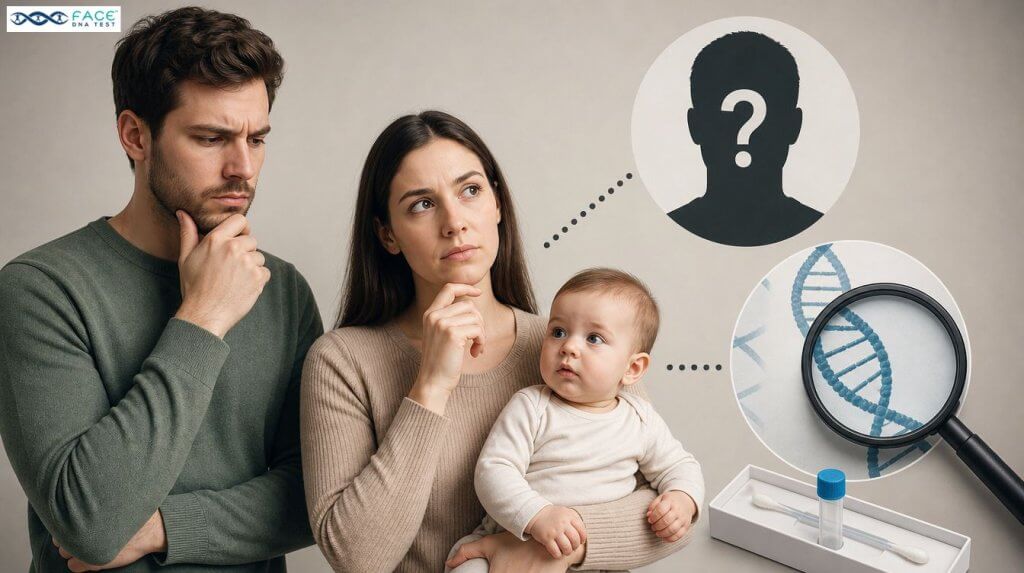
You don’t necessarily have to have the alleged father’s DNA to obtain answers that are useful, but his sample provides the most direct and useful answers. The best paternity test is to compare the alleged father’s DNA with the child’s DNA. However, life is never easy, and dads aren’t always there to provide a sample. Fortunately, there are ways for science to assist families in finding answers. In this blog, we will answer some frequently asked questions on paternity testing in lay terms, so that everyone can understand how it works.
Does the alleged father have to provide his DNA for a paternity test?
Yes, the most effective way to get a direct and accurate answer in a regular paternity test is the DNA sample of the alleged father. His DNA is tested against the DNA of the child to see if there is a match. This will ease the stress of any lab, as it is the gold standard way of doing it! An alleged father DNA test, performed with a simple cheek swab, can yield clear results in days and is painless and quick.
DNA Samples Needed for Paternity Testing
Typically, a paternity test requires a buccal swab from both the child and the alleged father. This swab takes cells in the mouth and will not cause any pain. DNA markers are compared between the two samples in the lab. Close match: This indicates that the person is very likely a biological father and is very accurate.
Can there be a paternity test between only the mother and child DNA?
The paternity test cannot be used when only the mother and child’s DNA is available for comparison, as the alleged father’s DNA is required to make a direct comparison. A DNA test without a father’s sample may provide useful information in certain situations; however, not in the same way. It focuses on inherited traits rather than a direct match, and thus may yield less specific answers than a usual father-child matchup.
Testing Without the Father’s DNA
- Mother’s DNA cannot be used to prove the father’s paternity
- There are some characteristics that can be studied and results are limited.
- A direct alleged father DNA test is the most obvious choice
- There are other family members who can fill the testing gap
What other DNA samples might be utilized in the event the alleged father can not be found?
If the alleged father is unable to participate, families don’t have to worry about that. Samples from close relatives are acceptable for labs as the DNA patterns will overlap. When a father has either died or is missing, or just refuses to test, this is often the only possible way to go about it. How do I establish paternity if the father is deceased? These alternate testing methods are frequently the ones that are relied upon to establish paternity.
Alternate DNA Samples for Paternity Testing.
- Samples of fathers’ grandparents’ DNA. Samples of fathers’ grandparents’ DNA.
- Brother/sister who shares the same alleged father
- Uncles and aunts from the father’s side of the family.
- Hair, medical records, etc. Samples preserved, such as hair or medical records
If the alleged father cannot get the DNA test, can the DNA of a relative be used?
Often, the question is asked: can grandparents be used for a DNA Test? Yes, when the alleged father cannot be found, relatives can be tested, and that’s where grandparent or sibling testing comes in handy. One common question asked is whether grandparents can be submitted for DNA testing. Grandparents share one-half of their DNA with their grandchildren, so comparing the DNA of the grandchild with the grandparent’s DNA can approximate their biological relationship. These alternative testing avenues are backed by trusted labs like Choice DNA that scrutinize them meticulously.
Testing with a relative of the father.
Shared segments of DNA are compared between family members in relative testing as opposed to a parent-child comparison. A grandparent, a sibling, an aunt or an uncle may be able to provide a sample to estimate the biological connection. Although it is not as accurate as a direct test, it is still helpful and informative to families.
The accuracy of various DNA Relationship Tests?
The degree of accuracy is dependent on the relatedness of the people being tested. A comparison of the father and child by a direct test is the most accurate and can achieve extremely high confidence levels. Testing by a grandparent, sibling, or aunt/uncle can also be useful but is usually given as a probability, not a certainty. This is because these relatives don’t share all of the child’s DNA with him/her. No matter which family member is tested, a CAP-accredited lab uses strict and standard procedures to ensure results remain as accurate and reliable as possible. That is why families should always choose an accredited lab for any DNA relationship test, not guess.
Trusted Testing Services You Can Rely On
Each family is unique, and this is where flexibility of testing options is important. Face DNA Test provides legally valid DNA Testing for paternity, prenatal, sibling, and grandparent testing to ensure families have confidence and clarity. Our non-invasive prenatal paternity test service, NIPP, is designed to help expectant mothers find out the answers safely, before the child is born, and all samples are sent to CAP-accredited labs.
Conclusion
It is not always the father’s direct DNA that will provide helpful answers; however, it’s possible for family members to intervene. Whether facing a crisis or not, Face DNA Test and the trusted partners they have, like Face DNA Test, have accredited testing options based on accuracy, privacy, and support. Regardless of whether the alleged father is present, unavailable, or family members are getting involved to help, our staff can help lead the family through the correct testing procedure with caution, accuracy, and professionalism, while also having a licensed expert review all testing.