
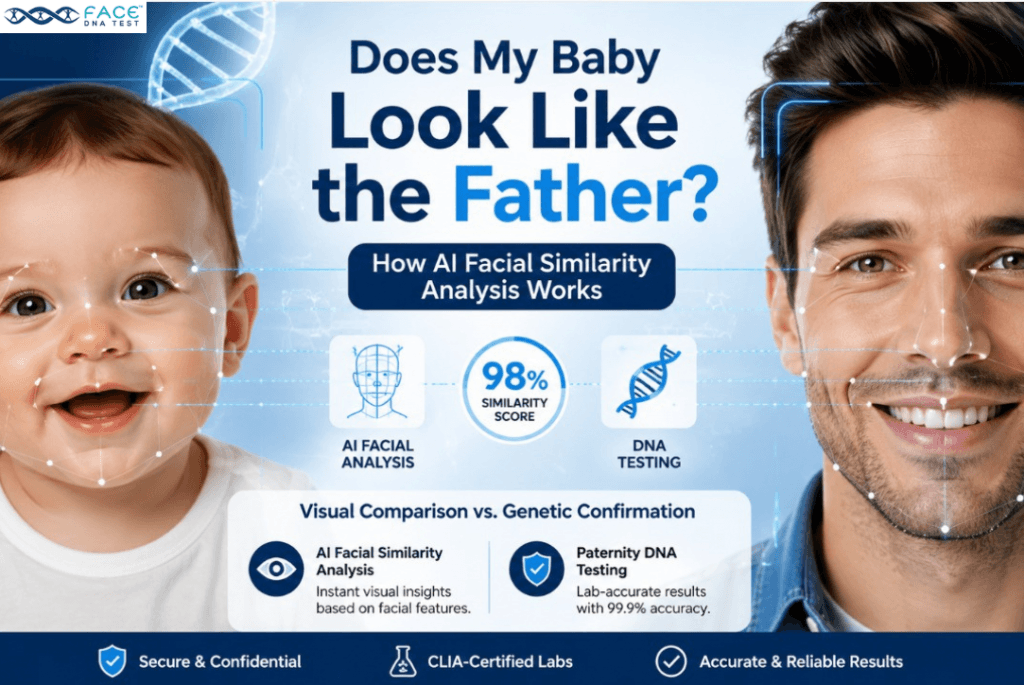

A baby’s face can be visually compared to that of a possible father, and in modern times, it can be done more quickly, intelligently and formally with the help of artificial intelligence tools. You may have seen a picture of your baby’s and wondered, “where did that nose come from? Where did those eyes come from?” “Does my baby look like the father?” In this blog we will discuss how facial similarity analysis works, what it can tell you and when professional DNA testing services are your next best step.
Is it possible to tell if a baby looks like their father with Facial Similarity Analysis?
Facial similarity analysis can be used to determine how close a baby’s face is to a possible father’s face but not, alone, to confirm biological parentage. It applies AI technology to make comparisons of structural features and generates a similarity score. That score is a visual one, not a genetic one. Though it is a good beginning for parents who are curious, nothing is scientific proof of paternity like paternity DNA testing performed in CLIA certified labs, which is medically and legally valid. The uses of visual comparison and genetic confirmation are two different, but complementary, functions.
What facial analysis can and cannot prove.
Facial analysis is the visual pattern recognition of two faces. It won’t confirm a relationship of any kind, cover up the fact that there is random genetic variation, or be used as legal proof. Genetics doesn’t always follow visual logic; two related people can look different, and two unrelated people can look similar.
What does the Facial Similarity Analysis do when comparing the features of a baby to the features of an alleged father?
The AI-powered facial similarity analysis compares both faces (the baby’s and the alleged father’s) and then analyzes hundreds of specific points found on each face. Then it measures distances, angles, and proportions between these points and recognizes patterns in structure they share. A similarity score is created from the similarity of the two faces. Face recognition application, where baby face comparison to father, takes this process further by using lab-driven methodology to ensure the comparison is logical and meaningful. The outcome provides a parent with a visual, data driven perspective into facial resemblance, without going into “DNA testing” territory.
Feature Matching and Pattern Analysis using Artificial Intelligence
Using precise algorithms, AI facial analysis maps out key points on both faces to obtain eye spacing, nose bridge, and jawline contour, and then measures the alignment of the facial structures. It yields a similarity percentage. It is objective and repeatable, but not a measure of genetic inheritance or biological markers that cannot be seen by the camera.
What kind of characteristics are typically compared to determine whether a baby is similar to his father?
The facial similarity test for paternity does not consider the face as an entire image. It segments it into specific areas with well-known inherited traits. All these regions are measured separately and then compared line by line. It helps parents to understand what is being measured so they can better appreciate what the results are and why some are more heavily weighted when comparing than others.
Eyes, Nose, Jawline, and Facial Proportions
- Eye shape and spacing: Eye shape and spacing, the distance between the outside corners and the shape of the eyelids, are among the most consistently inherited facial traits, and are utilized significantly in similarity scoring by AI.
- Nose width and bridge height: These are genetically stable characteristics and they can be used as reliable characteristics of comparison across all age groups, including infants.
- Jawline and chin structure: The angle of the lower jaw, the width of the chin and the general outline of the lower face tend to be structurally consistent among the biological relatives and are important in facial comparison analysis.
- This is looked at globally to assess the shape of the face, specifically the ratio of the length of the forehead to the length of the face, the placement of the cheek bones and the depth of the mid face to see if both faces have a shared structural template, which is genetically passed down.
What’s the accuracy of facial similarity analysis versus DNA testing?
The facial similarity analysis is a valid tool, but it has its limitations in terms of accuracy. If the mother has more easily observed characteristics, the baby could be more similar to her than to father even if the father is the biological father. On the other hand, if there are coincidences in the structures of the two people, the score may be misleadingly high. These restrictions are not bugs in the technology, but due to the complexity of genetic inheritance. Paternity DNA testing by CLIA certified labs offers an accuracy that an image-based tool can’t equal.
Visual Similarity vs. Genetic Confirmation
|
Conclusion
The face recognition feature in DNA’s app allows parents to find visual answers, and for those looking to go further, DNA testing services can be processed at CLIA-accredited labs for results that are confirmed and admissible in court. Be it merely a curiosity or a more involved case, there’s a tool to suit your cause.
If there is a question that is larger than a mirror, there is a science. Face DNA provides AI-powered facial similarity analysis and paternity DNA testing services, all powered by CLIA-accredited laboratories, allowing each parent to get professional-grade, reliable answers. Make a visual comparison, then when accuracy is critical, verified DNA testing will do the rest.