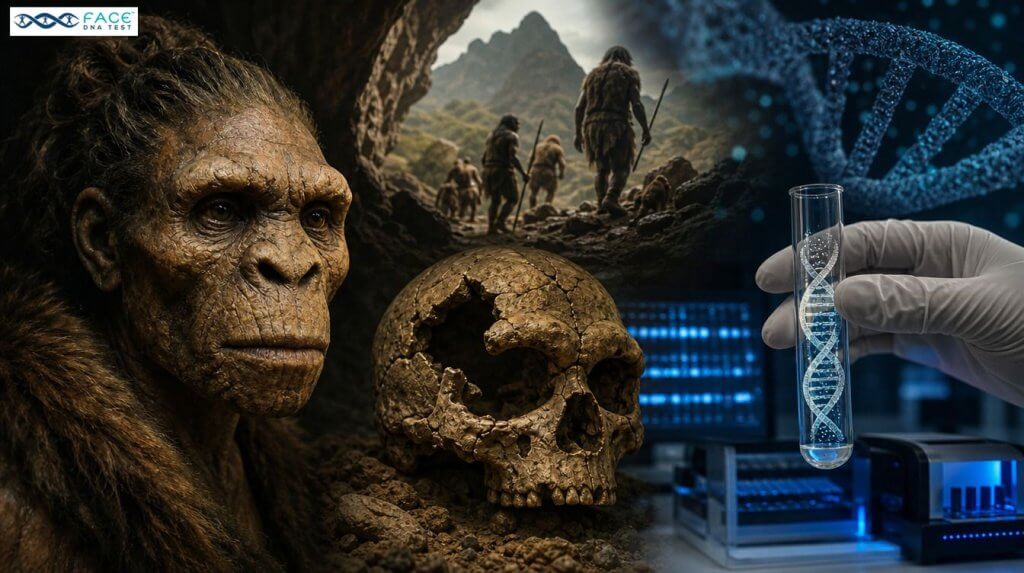
A skull that became entombed some 146,000 years ago has just been identified by its DNA as belonging to a human being. The skull was discovered in Harbin, China, in 1933 and was buried in a well for many years. Researchers who have identified the genetic traces of the Dragon Man fossil have uncovered evidence that they come from a group of early humans that had previously been virtually unknown to science: the Denisovans. In this blog, you can look at how researchers find ancient DNA, the information they’ve gleaned from Denisovan DNA, and how the same science falls into the family history tests people can take today. Now let’s get to know your distant cousins.
What is Ancient DNA Testing and why is it important in the identification of prehistoric human remains?
Ancient DNA testing involves extracting tiny fragments of genetic material from extremely old remains, such as bones and teeth. But what is ancient DNA? It’s the same type of DNA as all individuals have, only stored for thousands of years. It’s important because bones are sometimes difficult to name. Scientific information from the genes can be used to help determine the nature of the earliest human to whom a fossil belongs and to determine the genetic relationships between that person and other groups.
Role of Genetic research
- It plays a crucial role in the reconstruction of human history.
- Even if the shape of a fossil’s bones is not known, there are clues that allow genetic determination to be made as to which group of early humans it belongs to.
- DNA is used by scientists to create family trees, in which ancient groups are linked together to people today.
- Genetic outcomes can rectify outdated inferences given upon the shape of the bones alone, which in some instances bore similar appearances among groups.
- Scientists can determine when two populations diverged and went down different evolutionary paths, thereby dating the fossil record.
- New results can be compared with the old studies, allowing scientists to test if previous ideas still hold true.
What information might mitochondrial DNA provide about the evolutionary history of an ancient fossil?
Mitochondrial DNA is a minuscule segment of DNA floating outside the central DNA of a cell. It is passed down from mother to child. Scientists can easily retrieve it from old remains if other DNA has degraded, because it is abundant and strong in those remains. Researchers recovered ancient mitochondrial DNA from just 0.3 milligrams of dental calculus after earlier attempts to obtain usable human DNA from bone and tooth samples were unsuccessful. It is a way to see to which maternal line a fossil belongs and how close it is to other known lines. This provides the researchers with a first look at the position of an early human fossil in the human family tree.
Maternal ancestry can be determined with mitochondrial DNA.
The mitochondrial DNA is inherited with minimal mutation from mother to child, and therefore serves as a long-term record of a mother’s ancestry. During Dragon Man research, scientists compared this type of DNA to DNA sequences of other ancient and modern humans. The fossil was placed in the Denisovan family line in the match. The differences are small and serve as markers for the researchers to gauge in how close two groups are and how far back their common mother lived in time. This record is only one part of the story, since it only passes through the mother’s side of the family, and scientists contribute other evidence to fill in the picture.
How do scientists know that DNA retrieved from an ancient fossil is not contamination from the present day?
Scientists test for contamination in special clean rooms and by analyzing the appearance of the DNA. Modern contamination poses a major challenge, as nearly four-fifths of the human genetic material is contaminated from modern sources, making it essential to distinguish ancient DNA from contamination. There are certain chemical damage patterns in old DNA, and it is broken into short pieces. DNA of a contemporary handler doesn’t appear like this. The researchers can be more certain that the recovered DNA is indeed from the fossil if it exhibits the characteristics of old DNA. If the DNA recovered conforms to the expected characteristics of old DNA, the researchers can be more confident that the DNA is from the fossil. The various teams’ checks further enhance trust in the final result.
The methods used for authenticating ancient samples in the laboratory.
- Samples are kept in sealed clean rooms where the workers wear complete protective clothing to prevent contact with modern DNA.
- Scientists search for short, broken bits of DNA, which are a natural indicator of extreme old age.
- Work is frequently repeated in separate laboratories, and results that are the same become more convincing.
- Accidental contamination is prevented by testing control samples (no fossil material) at the same time.
- The outcome is compared to the known sequence of human DNA to establish that it is not the same sequence of a modern person who worked on the fossil.
What is the relationship between two human groups based on comparing the sequences of their ancient DNA?
Compares two DNA sequences by placing them side by side and counting the differences. The fewer differences the more recent the separation of the groups. The more differences, the longer the time span. Scientists can compare many sequences simultaneously and draw a family tree indicating when and which groups split off and which groups share a common ancestor. The more sequences they compare, the clearer the picture.
Genetic Matching and Evolutionary Relationships
Consider each DNA sequence as a long line of letters. If two groups share a recent common ancestor, the two lines will be very similar. As time passes, there are minor deviations and the lines begin to diverge. These changes are used by scientists to date the date of the split between two groups. This is why it became clearer that How Dragon Man Fits into Human Evolution: The fossil sequence was closest to the known Denisovan DNA and further away from Neanderthals and modern humans, indicating that it was on a different branch of the evolutionary tree. Newly discovered fossils and sequences continue to be tested by scientists.
Does DNA Testing produce any evidence of interbreeding between Denisovans and Neanderthals or modern humans?
Yes, a DNA test can confirm this. Denisovan genetic variants have been discovered in some of the world’s present-day inhabitants, and scientists have discovered evidence for shared ancestry between Denisovans and Neanderthals. This suggests that at times early human groups produced children as a result of mixed marriages. The Denisovans thus play a role in some of the present-day populations, but in varying proportions depending on the location. This is evidence and not an answer, say scientists, since new fossils can provide additional information.
Identifying Common Genetic Variants in all Human Populations.
- Scientists look at contemporary genomes to find short stretches of DNA that are found in the Denisovan genome but not in other groups.
- There are populations that have higher numbers of Denisovan variants than others, reflecting different histories of contact.
- The one ancestor who has been identified is an ancient “hybrid” who is a mix of Neanderthal and Denisovan genes.
- Shared variants are examined by numerous individuals, so the uncommon result doesn’t determine the outcome.
- By comparing the size of similar pieces, scientists can make an approximate guess of how long ago the mixing occurred because the older the mixing, the smaller the pieces are.
What if there is not enough preserved DNA in a fossil to be used for genetic analysis?
If there is not enough DNA, then scientists will use proteins. Proteins are constructed from DNA and, in fact, may persist in the cell longer than the DNA itself. A separate protein study identified 95 ancient proteins and 19,299 peptides from Dragon Man’s skull bone, providing independent molecular evidence supporting its identification as a Denisovan. Even if DNA is not present, these proteins can be used to reveal the group to which a fossil belongs. In real life, questions of ancestry are still relevant. Face DNA Test has laboratory partners that are accredited for conducting paternity DNA tests, mtDNA tests, and AncestryDNA tests for personal heritage questions.
Alternative Evidence from Ancient Proteins
- In certain situations, proteins could persist on bones, teeth, and even hardened plaque for much longer than DNA.
- Scientists decipher the code of a protein’s building blocks and compare it with the codes of other proteins they know have been found in humans.
- While researchers recovered mitochondrial DNA from Dragon Man’s dental calculus, a separate analysis of proteins from the skull bone provided independent evidence supporting its identification as a Denisovan.
- Protein evidence is less informative than complete DNA and is frequently used in conjunction with the latter to give more conclusive results.
- Some careful laboratory work remains to ensure that the protein is truly fossil and not of modern origin.
From ancient family trees to one’s own.
When people hear about Denisovan DNA, it can often raise their interest in their own heritage and the narratives associated with it. A heritage test can examine your very own DNA and contrast with massive populations. An mtDNA test is inherited through the mother’s line, a Y DNA test through the father’s line, and an AncestryDNA test will provide a clearer overview of the family’s ancestry. Many first ask how to find your ancestors and then, after they sign up to do the Ancestry DNA test, ask how long ancestry DNA takes after they enroll. Face DNA Test provides samples to recognized lab partners and is assisted by a licensed expert who can provide an explanation of the results.
Conclusion
Even after 146,000 years, the power of DNA is evident in the Dragon Man fossil. The same science is used to educate families about their families today. Face DNA Test provides paternity DNA testing, mtDNA and Y DNA testing in addition to AncestryDNA testing, by partnering with accredited laboratory partners, and you can explore your ancestry with care. Seek professional assistance when results are confusing. These tests will provide information on ancestry, a full picture of who you are. Results may also vary with the addition of new data and with further research. A licensed professional will be able to interpret your report.