
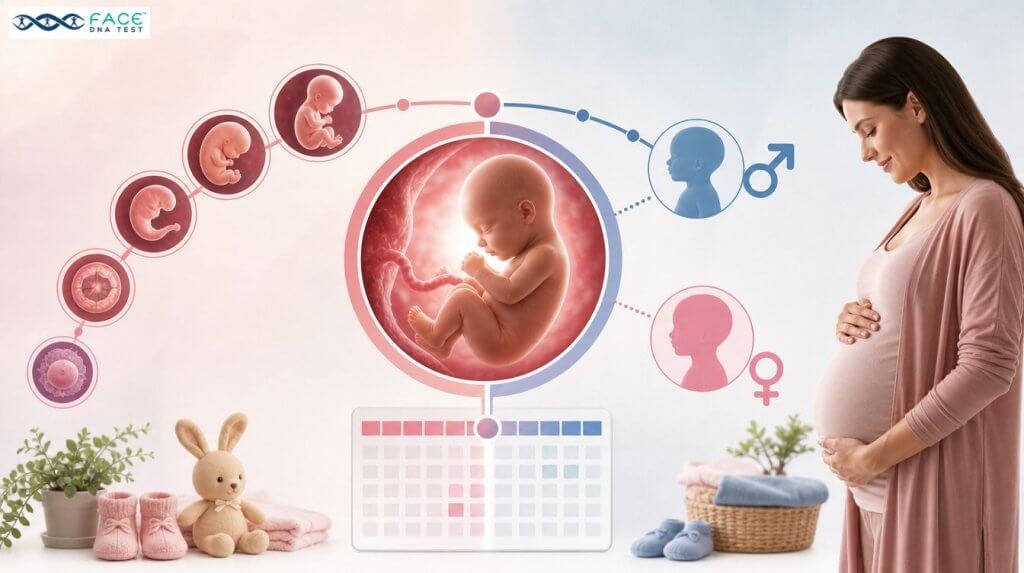

When is a baby’s gender determined? The short answer: a baby’s biological sex is determined at the point of conception, but the parts of the body that express the sex begin forming within weeks of pregnancy. Many parents can’t wait to know if they are going to have a boy or girl. Here we will discuss what exactly is meant by “gender development”, when sex can first be detected on a blood test, how a blood test works, the reliability of the test, and the tests that can help.
When does a baby’s gender develop during pregnancy?
Well, when they ask, “When does baby’s sex develop,” they’re asking about two things. The first question to ask: when is baby’s sex determined? That’s what occurs at conception when the sperm meets the egg. When the sperm has an X chromosome, the child is typically a girl. If it has a Y chromosome, the baby will most likely be a boy. Second, when the baby’s body begins to exhibit those differences. Sex organs start to develop around week 7 and continue to develop for many weeks.
Biological Sex vs. Gender: What’s the Difference?
The term “sex” is used by doctors to refer to body characteristics, such as chromosomes. Gender is a more comprehensive concept, a concept that develops later. So when is a baby’s sex determined? Parents inquire, “How early can you do a DNA test on an unborn child? During the first trimester, the body takes form. You can also determine a baby’s gender with prenatal sex determination.
Which week of pregnancy can the blood test determine a baby’s biological sex for the first time?
In a prenatal sex determination test such as NIPT, blood tests of the mother can identify the sex of the baby from about 9 to 10 weeks of pregnancy. Up to this time, the mother’s blood might contain so little of the baby’s DNA that a legible, readable result is not useful. Weeks are only calculated from the 1st day of the last period. Your doctor or testing provider can help you pick a time when you should test.
The Earliest Opportunity for Testing
Check dates: An early ultrasound can provide information on your progress.
Low DNA levels: If the sample contains an insufficient amount of fetal DNA, a repeat sample might be required.
Consider planning ahead: Testing a few weeks later will reduce retesting risk.
How does fetal DNA in the mother’s bloodstream help identify a baby’s biological sex?
The placenta secretes fragments of the baby’s DNA into the mother’s blood during pregnancy. This is known as cell-free fetal DNA. Fetal DNA testing involves taking a tiny blood sample from the mother’s arm. Within the lab, researchers search through this DNA for the Y-chromosome. If pieces of the Y chromosome are detected, the child is probably a boy. If not, then the baby is probably a girl. The test does not involve any contact with the baby.
Tracing Chromosomal Information
The mother has two X chromosomes and no Y. So, any Y chromosome found in her blood most likely comes from the baby. In labs, they will search for a gene called SRY, which begins male body development. A number of tests assess fetal dna content to corroborate the result.
Are early blood tests as accurate as an ultrasound at a later stage of pregnancy?
When performed at the proper stage of pregnancy by a good laboratory, early blood tests to determine the sex of a fetus can be very accurate. Research studies have shown that accuracy is very close to 100% from week 10 onwards. Another safe and regular method of sex detection is by ultrasound at about 18-20 weeks. It is looking straight at the baby’s body, however the baby’s position may make it difficult to view clearly. Both approaches are beneficial, and many parents use both to confirm each other.
- Twins: If one twin is a boy, the test may not show the sex of the other.
- Vanishing twin: When a twin’s DNA ceases growth, it can remain in the blood for weeks.
History of organ transplantation from a male donor may be a factor affecting results.
What else can NIPT determine about development of baby?
If sufficient fetal DNA is available, NIPT can provide information about the baby’s sex. screening test that is requested by a doctor. It primarily screens for some of the chromosomal disorders and many parents are also able to find out the sex of their baby. NIPP is a prenatal paternity test, a test based on the same type of fetal DNA, but addressing a different question – Who is the father? Face DNA Test’s accredited lab partners test samples, and we offer DNA testing services such as paternity and NIPP testing, along with relationship and At-home DNA Testing.
Conclusion
In which week is a baby’s sex developed? It’s present at the time of conception, begins to appear in the body around week 7, and is detectable in a blood test around week 10. Seek advice from someone to select the appropriate test and timing. Face DNA Test uses CAP-accredited laboratory partners to provide DNA testing.