
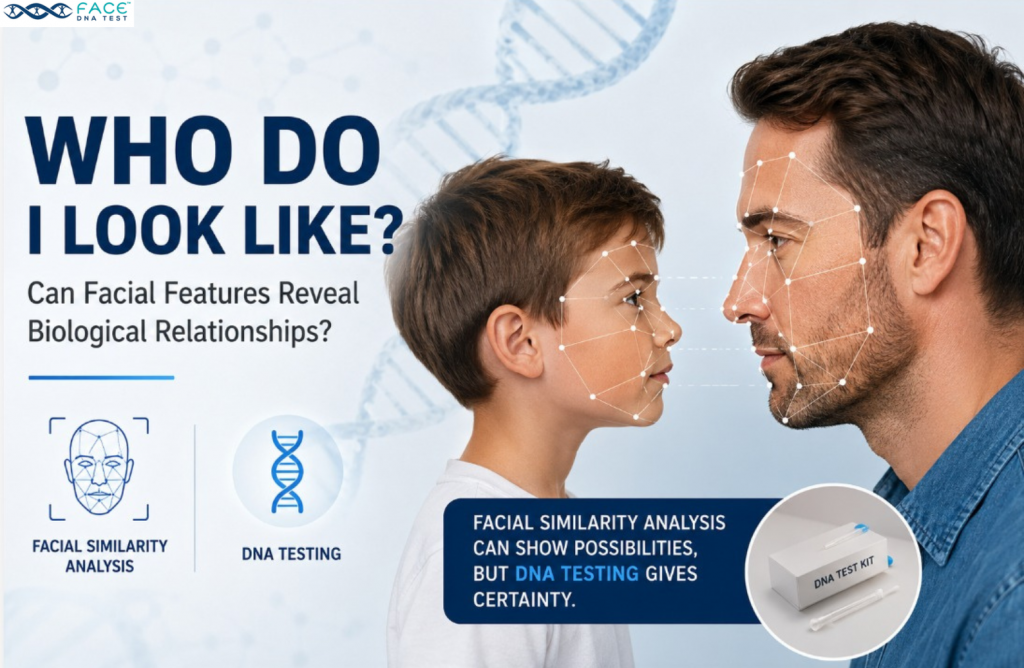

Although biological relationships can be suggested by facial features, they cannot be definitively established as with DNA testing. Many parents are aware that their child has their father’s nose or their grandmother’s eyes, and that’s the truth! But, what can facial recognition do in this scenario and what cannot? This blog will explain the science behind facial similarity Test, the very common inheritable characteristics of facial features and the fact that DNA testing is the only means of absolute proof of biological relationships.
Is there evidence of a Biological Relationship in the Facial Features?
Facial features can indicate a possible biological relationship but they cannot confirm one. The same genes affect the shape of the face, so family members may appear similar. But the nature of gene expression is complicated and variable. Two biological relatives can look very different and two people who have no blood ties can look very similar. Facial similarity is a legitimate initial basis for curiosity and not a scientific alternative to laboratory DNA tests where real DNA testing is, or should be, required, as in a personal, medical or legal context.
The Science Behind Facial Similarity
How does facial recognition work? The facial features are formed from the contributions of hundreds of genes passed through to the child from both parents. Some characteristics, such as the shape of the nose, the shape of the jaw, and the size of the eye spaces, are genetically determined to a high degree. The technology can objectively measure and compare these structural patterns, but due to the fact that there are many identical faces in the world, these patterns can show the genetic probability of a person, not a biological connection between two persons.
What are the most common genes that are passed down from the Biological Parents?
There are several features of the face that have consistent patterns of inheritance, such that they are seen more consistently in biological family members than other features. With this information, it’s easier to understand why there is focus on certain parts of the face for facial similarity analysis when compared to the whole face.
Eyes, nose, jaw, and other genetic traits.
- Facial features that are consistently heritable and used in facial recognition software comparison analysis include eye shape and spacing (the distance between eyes), eyelid shape, outer corner angle, etc.
- Nose shape and bridge height are highly heritable; nose width, bridge prominence, and nose profile are also highly heritable and are often transmitted between generations.
- Jawline and Chin Structure — other lower facial features such as the shape of the lower face, jaw angle, and width of the lower jaw also tend to be structurally consistent across biological relatives, and contribute substantially to facial similarity scores.
- When comparing two faces structurally, facial proportions are considered as a part of facial recognition search technology; that is, the ratio of the forehead to the length of the face and the position of the cheekbone is looked at together.
Is Paternity or Other Family Relationships Correctly Identified by Facial Similarity?
Facial similarity analysis is not an accurate means of determining paternity or confirming biological parents. It gives a comparison to the eye, not a genetic one. It is important to know the difference between facial analysis and DNA testing before making any decisions based on a facial similarity.
Facial Analysis vs. DNA Testing
| Facial Similarity Analysis | DNA Testing |
| AI-based photo comparison | Laboratory genetic analysis |
| Measures structural similarities | Measures shared genetic markers |
| Produces similarity percentage | Produces biological match probability |
| Not legally admissible | Court admissible |
| Indicative only | 99.9% accuracy for paternity |
| Instant results from photos | Results in days from lab |
What are Facial Similarity Tools and Face-Matching Technology?
Facial recognition is based on a series of landmarks being measured on a face, a structural map of the face being compared to another face, and a similarity score being calculated. Knowing how facial recognition works can help you understand what it can and cannot tell you about biological relations.
Examining facial characteristics and genetic traits
The facial recognition software analyzes hundreds of landmark points on both faces being compared. It measures the similarity between the structure’s main features (eye spacing, nose width, jaw angle and so on) and returns a similarity score in percentage. In this context, facial recognition is not an instrument for analyzing genetic relations, but rather an advanced measurement device.
Face DNA Test provides a Facial Similarity Test and Face DNA App with cutting-edge facial recognition search technology, providing an objective, AI-driven visual comparison of two faces. These tools are meant for information and not for biological confirmation.
Conclusion
It is important to remember that facial features provide very useful evidence of biological relationships, but evidence is not proof. Face DNA Test offers you both tools: visual exploration with facial similarity analyses and scientific certainty with professional DNA tests. If the answer really counts, go to the lab, not the mirror. Face DNA Test offers professional DNA paternity test, Facial recognition app and DNA testing services with full chain of custody documentation for confirmed paternity results. When it counts, seeking out the expert’s facial comparison gets the ball rolling and DNA provides a definitive end to the discussion.